Fifteen minutes re-explaining yourself at the start of every session. Copy-paste between Claude and Cursor. Ferry the same three files into four different tools. You asked the AI to do work for you, somehow you're the one running the errands.
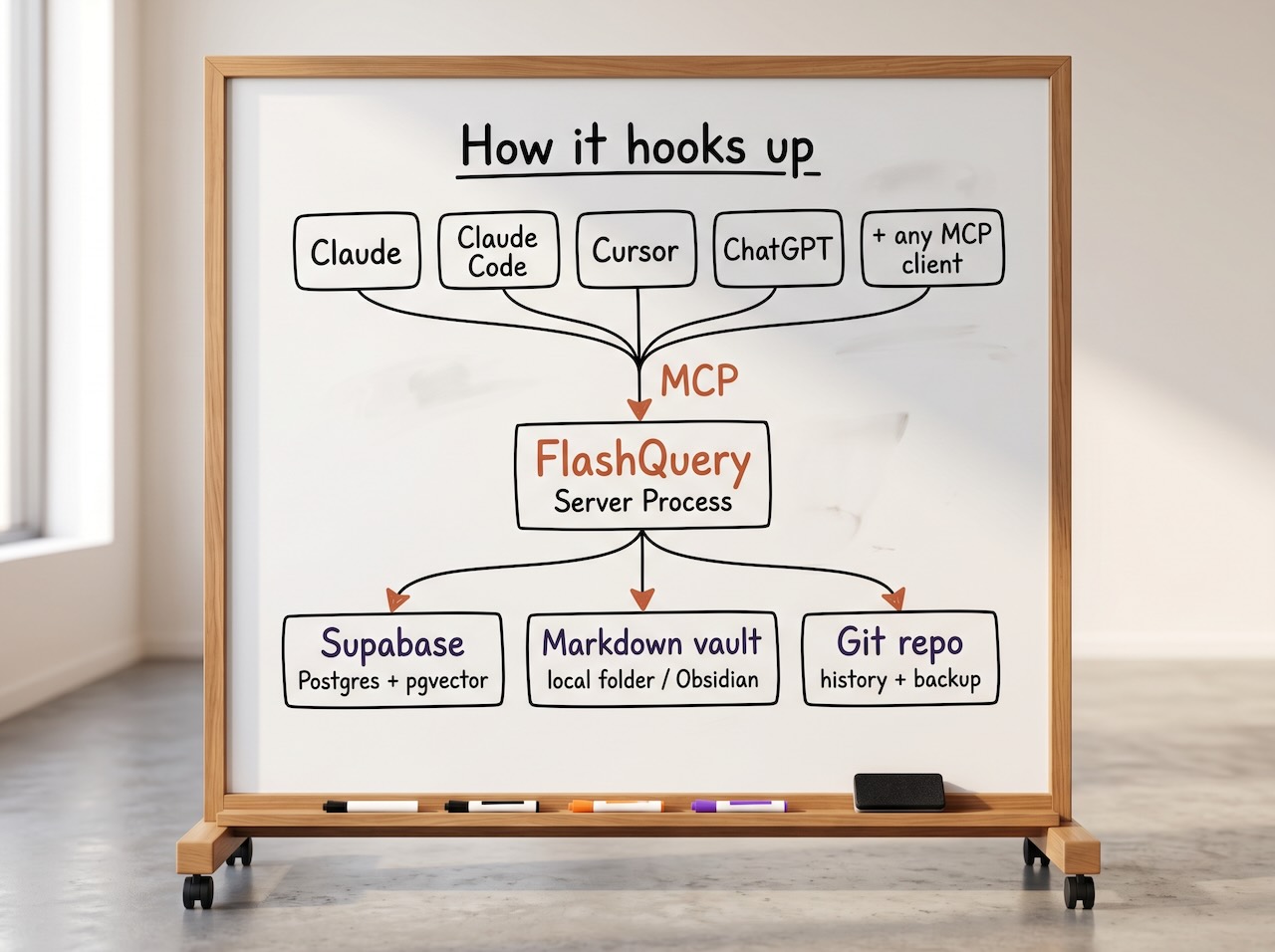
FlashQuery is the data layer that stops the errand-running. It connects the models to your stuff - your selected files and memories. Every MCP-compatible AI tool can read and write to.
git clone https://github.com/FlashQuery/flashquery
People have started calling it context loss. You just want to say, "Hey, remember we talked about this?" This digital amnesia is leaving the parking brake on while trying to accelerate.
"A glorified human clipboard. Copy, paste, repeat. Copy, paste, cry a little."
— Developer post, builder.io"My workflow is 70% AI, 20% copy-paste, 10% panic."
— Hacker News"AI coding tools still suck at context."
— LogRocket, 2026Harrison Chase (LangChain): "In order to own your memory, you need to be using an Open Harness." Nate Jones's agent stack analysis and Locked In make the same case from the infrastructure side.
Since early 2025, developers have been independently building persistent-memory systems for Claude Code. At least a dozen HN posts. Each solves part of the problem, but none spans all of it.
FlashQuery is what happens when that layer gets built once, in the open, across every data type.
git push backs it up.
Built on:
Nothing proprietary, no vendor-controlled backends,
privacy-first, and stable.
If FlashQuery
disappeared tomorrow, your data remains yours.
TL;DR: This is the months of plumbing you'd prefer not to build.
Drop a markdown doc in the vault folder on
your filesystem. FlashQuery sees it, watches
for changes, makes it semantically
searchable. Edit it in TextEdit, Obsidian,
VS Code, Vim, Emacs, whatever you use. No
import workflow or sync daemon, and no app
to open.
ls it, grep it,
git blame it. Your folders are
the system.
Memory lives in Postgres, managed by FlashQuery. Claude, Cursor, ChatGPT, Qwen, local models — all of them can read and write memories. Switch tools or models; the context doesn't reset because it was never inside any of them. Scope memory to a conversation, a project, a person. Then query it like the database it is.
If your vault folder happens to be a git
repo, every document dragged into to the
vault, every edit an agent makes, every
decision written down are committed to Git
with a descriptive message.
git log to see what changed.
git diff to see exactly how.
git revert to undo anything the
AI touched. Your vault is an auditable
record of changes.
We built section-aware markdown doc tools. AI can get a synopsis without loading the whole document, insert a paragraph without rewriting the rest. Your token budget goes to reasoning instead of parsing. The MCP tool surface is designed so the model does the least work necessary to answer the question.
Claude Code, Cursor, ChatGPT Desktop, Cowork, Claude Desktop — one MCP config entry per tool, same vault, same memory, same plugins behind all of them. Add a plugin once and every connected tool sees its new capabilities automatically. No per-tool integration work to maintain.
FlashQuery is an MCP server. Point a Cloudflare Tunnel or Rathole at it and your entire data layer — vault, memory, plugins — is reachable from anywhere over a private connection you control. Your files stay on local disk. Nothing changes about how your AI tools connect to it.
Full architecture, plugin spec, and MCP tool surface: github.com/FlashQuery/flashquery
A plugin is a schema and a set of skills. FlashQuery handles the rest: storage, versioning, search, the MCP surface.
Contacts, businesses, opportunities, interactions, all in FlashQuery's data layer. No separate database, no login, no UI.
"I just had coffee with Sarah Chen, VP of Design at Meridian Labs."
Routes into Supabase, the vault, and Git at once. Later: "brief me before my Meridian call" returns everything the system knows.
A durable, queryable knowledge layer for the product you're building: definitions, research, decisions, requirements, tracking. Who needs Confluence?
"Why did we decide to store documents in Markdown instead of the database?"
Answer sourced to the decision document, because the document and the database share the vault.
A skill registry built as a FlashQuery plugin,
Your .claude/skills/ directory with
versioning, semantic discovery, and a
telemetry-driven improvement loop.
Designed, on the roadmap.
The plugin spec is open. Browse the plugins repo · Join #flashquery on AI Product Hive if you're building one.
FlashQuery has been built and tested inside Claude Code and Cowork. The CRM and Product Brain plugins are in daily use by the FlashQuery team. This isn't a lab demo, it's the environment the project lives in.
FlashQuery is a scoped server process. No cloud dependency, no telemetry, no account required. Connect it as a local MCP server and Claude Desktop, Claude Code, or Cursor can read and write your vault on the $20 Claude subscription, no Cowork needed.
Stand up FlashQuery on a VPS or personal Supabase project you control. Same vault, same plugins, reachable from every machine. Nothing hosted by FlashQuery.
PDFs, Word docs, spreadsheets, same drop-in workflow.
Drop a non-Markdown file in the vault. A cheaper model handles the embedding pass so the expensive model gets structured context, not a raw binary. Same folder, more file types, no extra setup.
Plugins from the community.
The CRM and Product Brain plugins are the first two. The spec is designed for anyone to build against. We expect the third plugin won't come from us. It'll come from someone in #flashquery who needed something we hadn't thought of.
Describe what you want to track. FlashQuery builds the schema.
Tell FlashQuery in plain English what you need. It designs the right Postgres schema, creates the tables, wires up the MCP tools. You can export the result as a shareable plugin when you're done.
Document projections: the expensive model reads a summary, not the whole file.
A cheap model preprocesses vault documents into compact, skill-specific views. The expensive model reasons against that view instead of the raw file. Same document, as many projections as there are skills that use it. Token budget spent on reasoning, not parsing.
git clone https://github.com/FlashQuery/flashquery
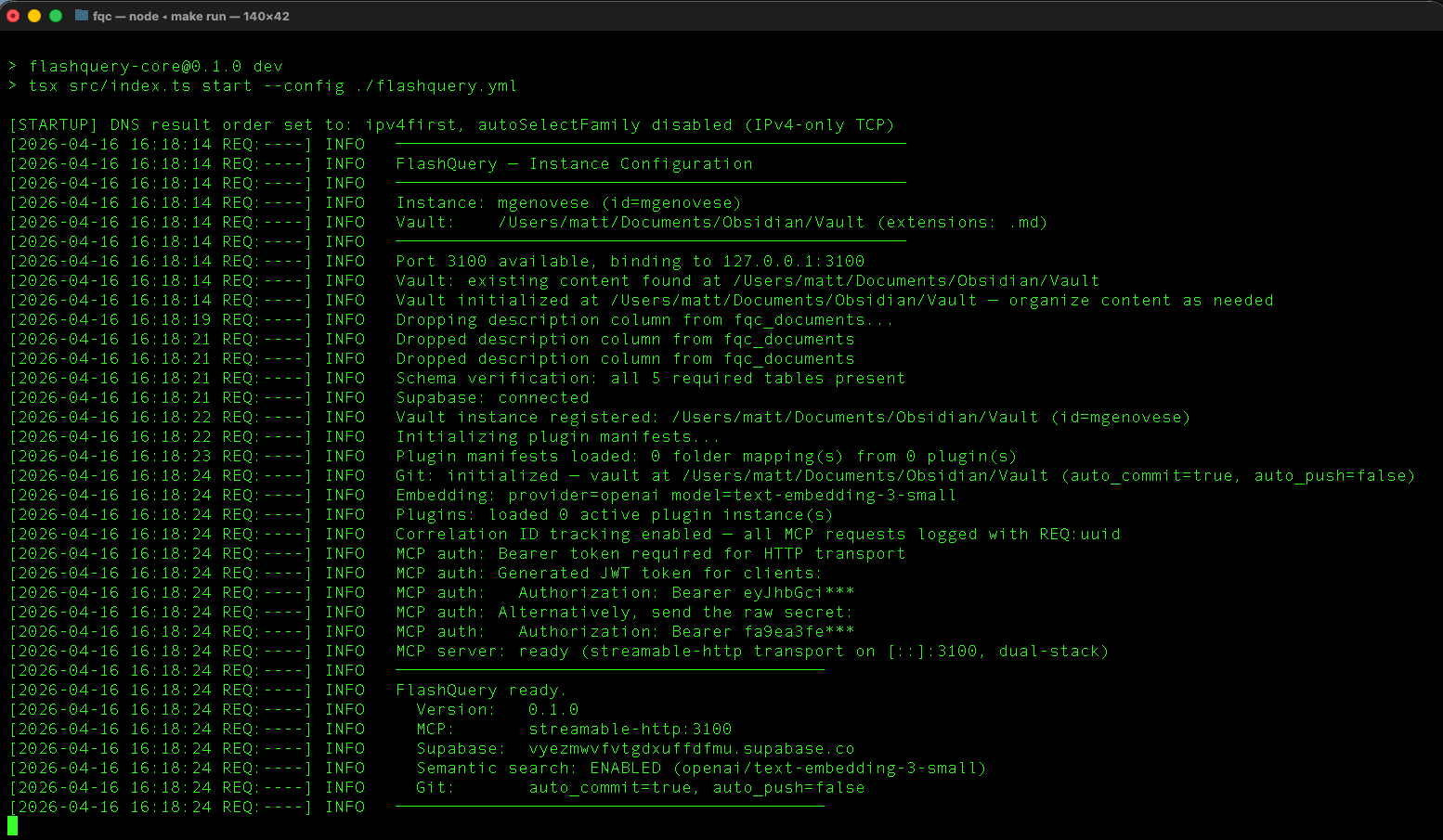
Full setup, plugin spec, and architecture notes live in the repo.
View on GitHubBest place to try it today: Claude Code or Cowork.
Find us in #flashquery on AI Product Hive.
Demo video coming soon.